
My Proposal

OSHI’S Mission
The Open Source Healing Initiative (OSHI) was founded by James Halls, who was inspired from his own battle with addiction. Before starting OSHI, James worked in corporate finance and consulting jobs in London. Despite his career being successful, he still struggled with alcohol and drug addiction. After facing serious health issues, such as repeated sepsis that required hospitalisation, he decided to make a major life change and focus on recovery. This created a turning point which lead him to want to help others with similar issues.
After returning to Hull, where he had gone to university, James began volunteering in recovery-focused organisations. Where he noticed gaps in support systems and felt there was a better community-based support. This led him to create OSHI as a “recovery incubator” offering quick and accessible help to people in need. Today, OSHI includes over 30 team members and provides one-on-one coaching, support groups, and other services to assist people on their recovery journey. (Information from C4DI Real Stories.)
Initial Design Ideas and Inspiration Sources.
The existing branding is quite simple, making it easy to maintain consistency. The colour palette uses just a few colours; blue, grey, white, and black. The logo which is a lotus leaf, aligns with this simplicity and represents finding inner peace after overcoming addiction. While adding a unique detail could make the logo more memorable, this isn’t urgent given the brand’s focus and purpose.
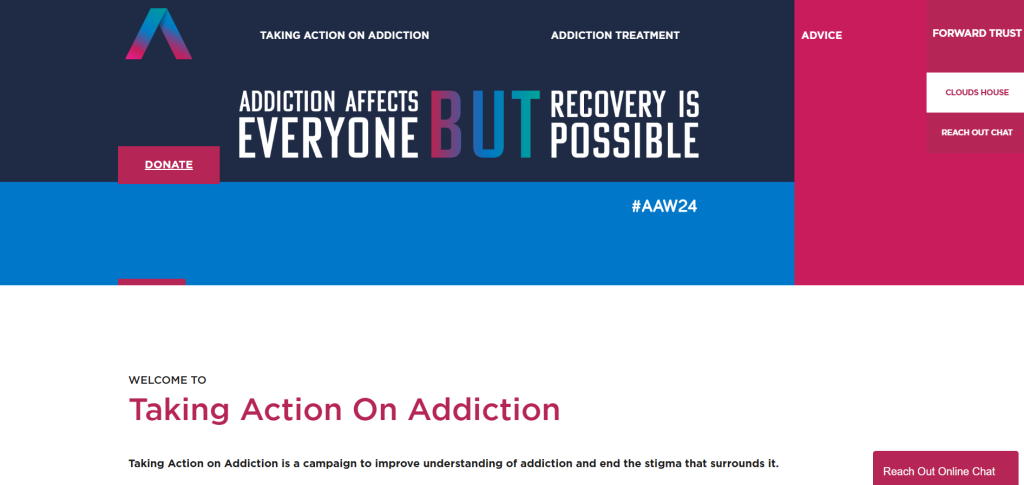
Taking a look at Forward Trust’s landing page which is a competitor to OSHI, we see that in contrast to OSHI there is more colour on the landing page. This creates a warmer feel to the website with the use of the dark pink colour combined with the blue. This is as some people may find OSHI’s current white and blue theme too cold. However Canva’s (2019) colour guide page says “Light blue is a peaceful, calming colour. According to colour psychology, blue is associated with trustworthiness and reliability.” which could argue that the use of blue in OSHI’s page has a positive effect on the user and doesn’t need changing.
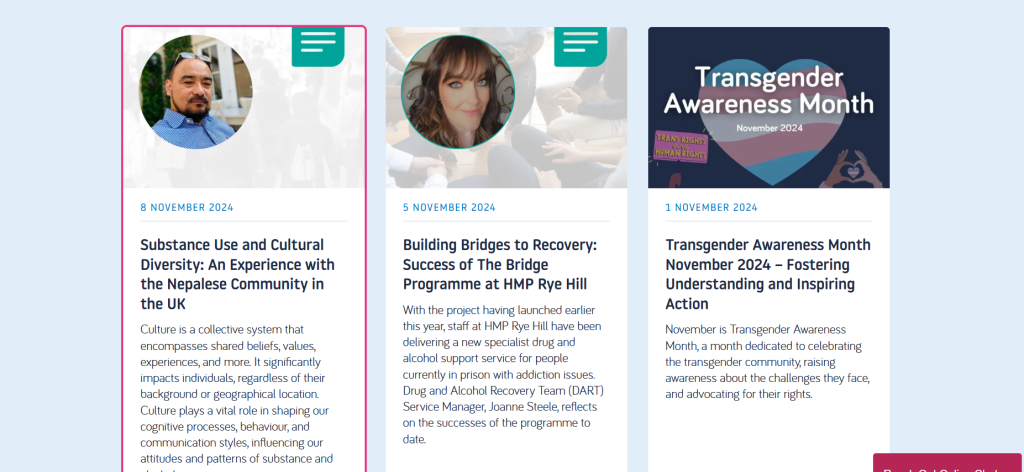
Taking another look at the competitors page it is visible that buttons interact in a different way in comparison to OSHI’s website. In the Forward Trust site we see that buttons develop an outline meanwhile OSHI’s buttons have no interaction at all or slightly change colour. Inspiration can be drawn from the Forward Trust site and interactions can be added or changed on it’s current buttons.
Target Audience Analysis
OSHI’s target audience is adults who are dealing with addiction and who want to get support with overcoming their addiction. The organisation focuses on adults since addiction issues often affect them the most. Alongside people actively struggling with addiction, OSHI also supports those already in recovery by offering counselling and peer-led support to help them achieve long-term sobriety and mental well-being.
OSHI also serves people facing related mental health challenges, like depression, anxiety, or trauma, which often come with addiction. This approach makes OSHI a valuable place for those looking to overcome dependency and for anyone needing continued support to rebuild their lives. The organisation’s focus on quick and accessible services such as personalised coaching and therapy appeals to people who need immediate help.
Objectives For The Multi-Channel Marketing Strategy.
A multi-channel marketing strategy is a plan that uses different platforms to communicate with an audience. Rather than focusing on just one channel, this approach combines several methods like social media, email, events, website content, and advertising to engage with users or partners This strategy helps maximize reach by using multiple ways to connect.
One major objective for OSHI’s multi-channel marketing strategy would be to set up social media. This is as the social media icons at the bottom of the website only takes the user to the “Contact Us” page. Instagram and Facebook can be used to regularly post content that inspires and engages the target audience. Share stories of people in their recovery journey, provide updates on upcoming events, and upload educational posts. These platforms allow OSHI to reach a broad audience and connect with users seeking encouragement and community.
Another objective for OSHI is to host more in person events focused on mental health and addiction, allowing users to learn and connect with similar people together as a community. This’ll increase the return rate of users for further events and bring in new users as highlights of the events can be posted online on Instagram Reels or TikTok which goes hand in hand with the first multi-channel objective.
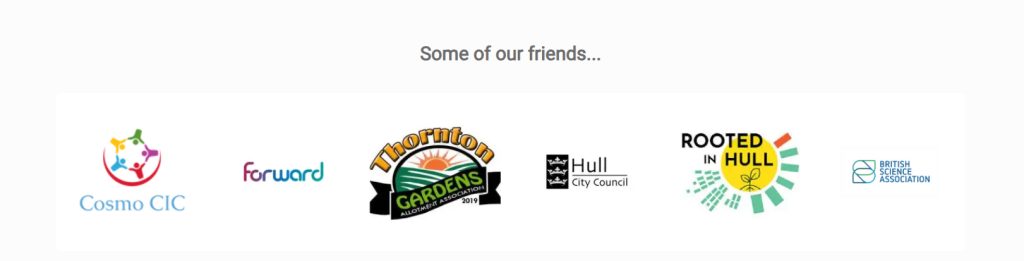
An objective that also links to social media is to create links for the “Some of our friends…” section as these have images of logos of partnered organisations however there is no link. This can be easily upgraded as the logos could be turned into clickable logos which take the user onto the partnered site, partnered sites can do this too for OSHI and increase the link building for all organisations involved which will result in a higher ranking.
Key Features and Functionalities To Be Included In The New Web Presence.
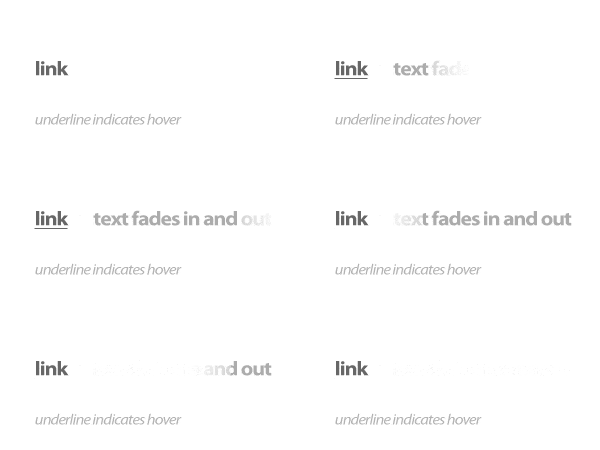
Key features inside the new web presence will include animations as this is clearly lacking inside of OSHI’s current website. The animations can be subtle as too much over the top animations may overwhelm the user. Some examples of simple animations are a “fade in” or “drift” animation which could be applied to titles to give the page more liveliness.
This website has multiple accessibility issues that need urgent fixing, as they could prevent a large part of the target audience who are visually impaired from using it. These fixes in the new web presence will include adjusting contrast settings to improve readability, this will include a dark mode by default to decrease the carbon footprint the website emits which will also improve the websites ranking. Secondly ensuring every image and link has clear descriptions so screen readers can interpret them effectively.
References
Goodfellow, T. (2023) C4DI Real Stories. C4DI. Available online: https://www.c4di.co.uk/news/2023/6/2/corporate-finance-cocaine-and-connecting-people-to-recovery [Accessed 7 Nov. 2024].
Canva (2019) Light Blue Meaning, Combinations and Hex Code – Canva Colours. Canva’s Design Wiki. Available online: https://www.canva.com/colors/color-meanings/light-blue/ [Accessed 8 Nov. 2024].
OSHI (2024) Contact | OSHI. Oshi.org.uk. Available online: https://www.oshi.org.uk/contact/ [Accessed 10 Nov. 2024].
Bobe (2012) CSS fade left to right. Stack Overflow. Available online: https://stackoverflow.com/questions/12686738/css-fade-left-to-right [Accessed 9 Nov. 2024].