
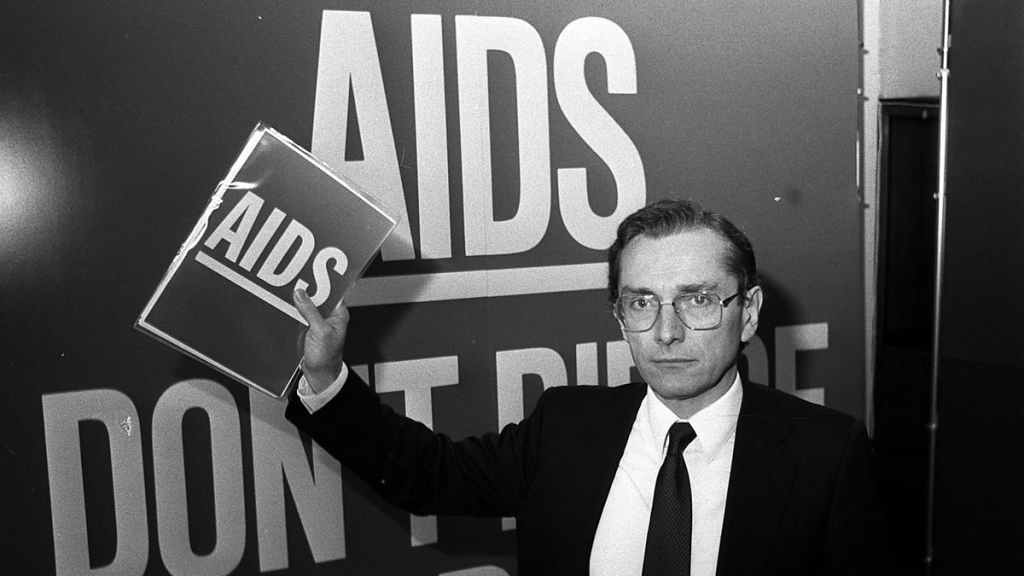
In 1986 the British government launched the world’s first ever public health campaign on AIDS. It was highly controversial and faced opposition from the Prime Minister at the time, Margaret Thatcher. The purpose of this campaign was to educate the public about AIDS as there was an incredibly large amount of stigma at the time surrounding people suffering from AIDS. This was due to the increasing rise of cases in the UK. This meant that newspaper adverts were published, a leaflet was sent to every home in the UK, and a television advert was also aired. Norman Fowler claimed that “90% of the public recognised the advert and a vast number changed their behaviour because of it” and as it was a “life and death situation…There was no time to think about whether it might offend one or two people”.
TV Advert
This video advertisement is a part of the AIDS information campaign. It showcases a volcano and an iceberg which are visual metaphors to show a direct association with death, with the intention too scare the public and take the issue seriously. Another example is a man chiselling the word “AIDS” into stone. This is a metaphor for the inevitable outcome of coming into contact with AIDS and also represents the rising amount of deaths inside of the UK from AIDS. Malcolm Gaskin, the designer at TBWA stated that scaring people was deliberate and needed to ensure that the public took the threat seriously and tried their best to remain safe and vigilant against AIDS.
Information Leaflet
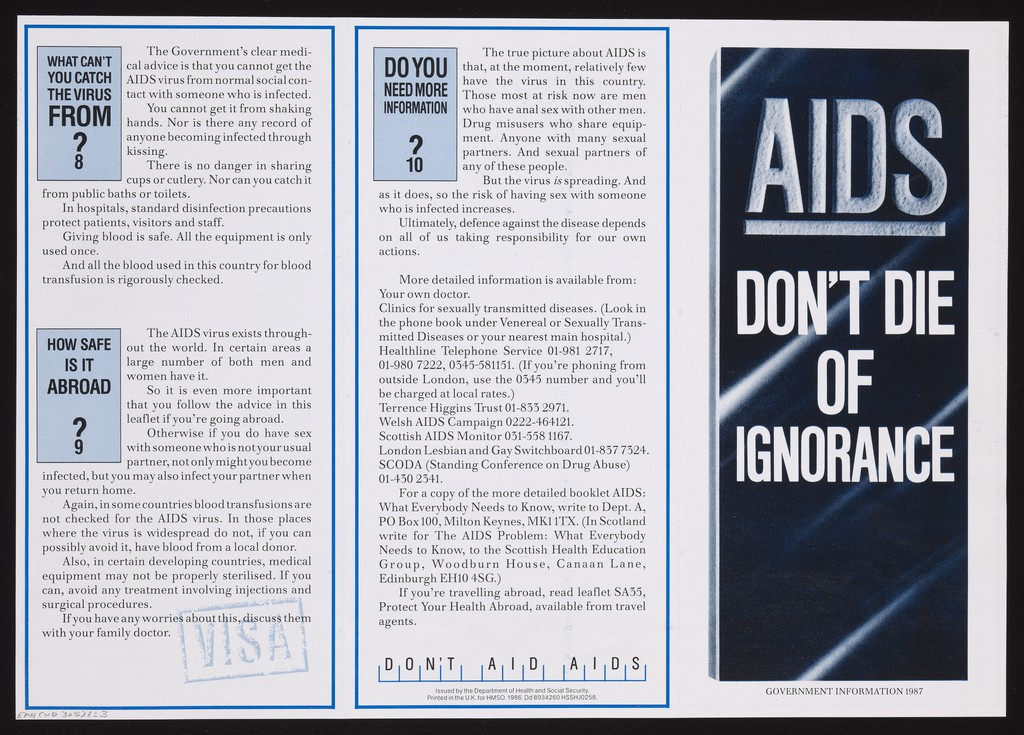
Here we see the information leaflet that was sent to every home inside of the UK to help inform everyone about how to keep safe from AIDS. The front cover of the leaflet contains black and white as it’s colours, emphasizing a depressing and apocalyptic atmosphere similarly to the TV advertisement that was created.
Impact
The impact of this campaign was highly successful in bringing the issue into the public awareness, with a staggering 90% in public recognition. It helped change sexual behaviour within the public and reduce the spread of the virus, making the infection rate lower inside of the United Kingdom than in many other countries by 1990. However, the campaign was heavily criticized by some people for being “victim-blaming“, which led to a continued stigma surrounding people with AIDS. Overall, this campaign shows how being brutal and upfront about topics can have a large scale impact on society, both good and bad as we can see from the 90% recognition rate and decreased cases, but also from the continued stigma.
References
Wikipedia contributors (2021) AIDS: Don’t Die of Ignorance. Wikipedia. Available at: https://en.wikipedia.org/wiki/AIDS:_Don%27t_Die_of_Ignorance (Accessed: 15 February 2026).
YouTube (1987) [Public Awareness Broadcast] – AIDs Monolith [YouTube]. Available at: https://www.youtube.com/watch?v=nZuP528HtKs (Accessed: 15 February 2026).
Department of Health and Social Security (1986) AIDS: don’t die of ignorance: government information 1987 [online]. Wellcome Collection. Available at: https://wellcomecollection.org/works/kx943x59 (Accessed: 15 February 2026)
Jeffries, S. (2017) How we made Don’t Die of Ignorance – the AIDS campaign. The Guardian. Available at: https://www.theguardian.com/culture/2017/sep/04/how-we-made-dont-die-of-ignorance-aids-campaign#:~:text=Nobody%20even%20knew%20what%20to,and%20she%20was%20probably%20right (Accessed: 15 February 2026).
Creative Review (n.d.) Can graphic design save your life?. Available at: https://www.creativereview.co.uk/graphic-design-save-life-wellcome-exhibition/#:~:text=design%20and%20health.-,Can%20Graphic%20Design%20Save%20Your%20Life?,alongside%20powerful%20anti%2Dsmoking%20communications (Accessed: 15 February 2026).
Wikipedia contributors (n.d.) AIDS: Don’t Die of Ignorance. Wikipedia. Available at: https://en.wikipedia.org/wiki/AIDS:_Don%27t_Die_of_Ignorance#:~:text=AIDS:%20Don’t%20Die%20of%20Ignorance%20was%20a%20public%20health,television%20advertising%20campaign%20was%20aired (Accessed: 15 February 2026).